SEO + GEO + AEO: Exploring New Modern Shift From Search Rankings to Digital Answers, Driven by User Intent

People today don’t just type words into a search bar. They ask real questions. They expect answers instantly. The way search works has changed fast. The old ranking system is giving way to smart answers delivered straight on search rankings pages.
In 2025 and early 2026, more than 1.5 billion people got answers through Google’s AI Overviews every month, showing how big AI search has become. At the same time, studies show over 58% of Google searches now end without a click to a website.
This tells us something huge: users want quick answers first. They want relevance.
They want clarity. For businesses like C2C Media, understanding this shift is key.
In this blog, we explain the shift from old search rankings to new digital answers. We break down SEO, GEO, and AEO. You will learn how search is evolving. And you will see what this means for businesses who want to stay visible and relevant online.
The Old Days of Search Rankings: A Simple Start
Early search engines ranked pages by links and keywords. You made content with keywords. You built links. Then your page showed up on top. Back then, ranking high meant traffic and leads. But search today is very different. Users do not always click links any more. They get instant answers.
This shift has changed how brands build presence online.
What Is SEO Today?
Search engine optimization began as a way to improve page rank in search results. Marketers used keywords, meta tags, and links to climb the ranks.
SEO worked when users clicked results and visited sites. It was about ranking on page one. But that world is changing. The rise of AI search and instant answers has altered how users find content and how brands need to show up.
Why SEO Still Matters?
Even with new search rankings models, SEO is still important. People still use search engines billions of times every day. Good SEO helps search systems understand your content. That means your brand still gets seen. But now, search isn’t only about ranking on top. It’s also about being part of the answer the search engine gives.
Enter AI: The New Search Rankings Experience
With AI search growing fast, search engines now provide direct answers. This new trend is reshaping how people search rankings. Search engines use deep language models to understand questions and deliver results that feel like a conversation. Users no longer need to scroll or click.
They get what they need right away. This trend is pushing marketers to rethink how they show up in search.
Understanding AEO and GEO
Today’s search calls for two new ideas: AI Search and Answer Engine Optimization and Generative Engine Optimization.
-
- AI Search and Answer Engine Optimization makes sure your content appears in AI summaries and quick answers. It goes beyond old SEO. It’s about giving search engines clear answers they can reuse.
-
- Generative Engine Optimization means creating content that works well with AI-powered engines like Gemini, ChatGPT Search, and Perplexity. It makes content easy for machines to understand and share.
Together, these approaches change how brands build visibility in search rankings.
Importance Of Optimization in Digital Marketing
Optimization is still the backbone of digital visibility. Whether you aim for search rankings or direct answers, optimized content speaks clearly to both humans and machines. Good optimization helps you reach users at the right moment. It helps brands stay visible even when users don’t click links.
Zero-Click Search and AI Results
The rise of AI summaries means many users no longer click on links. Studies show that over half of Google searches now end without a click. This “zero-click” behavior changes the rules. Websites can rank high but still get little traffic.
Brand visibility now depends on being featured in the answers, not just in link lists. This is where AEO and GEO help brands survive and thrive.
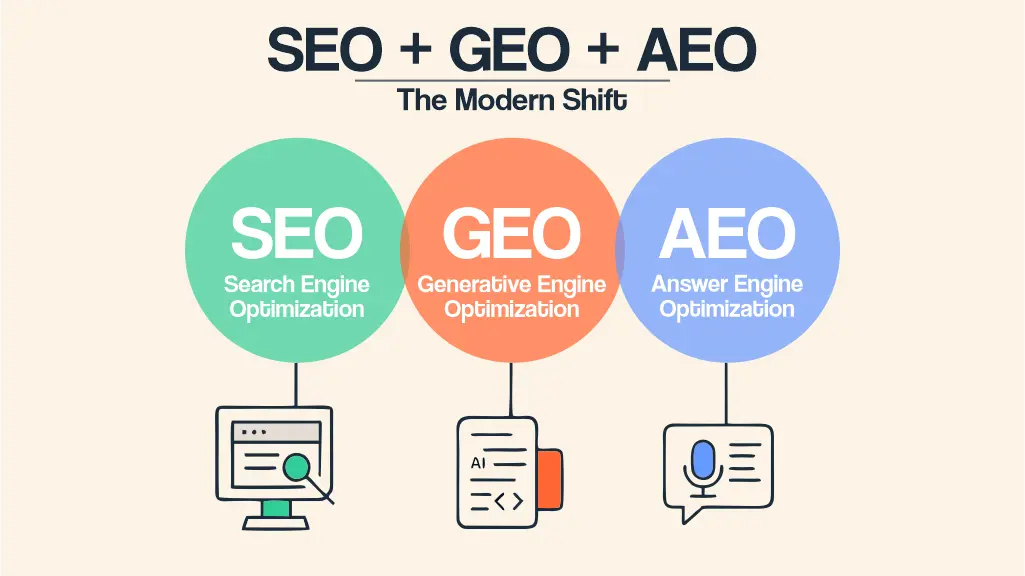
SEO Vs GEO Vs AEO
Now let’s compare the old and new ways of search rankings optimization:
-
- SEO focused on ranking pages high for search rankings queries.
-
- GEO focuses on optimizing for generative and AI search Rankings engines.
-
- AEO focuses on optimizing content so AI can use it in quick answers.
Each has value. But the new world needs all three to compete.
Why be ranked when you can be the answer?
Our SEO, GEO, and AEO framework positions your brand where Dubai buyers actually decide.
Evolution Of Search Optimization Models
Search optimization used to be simple. You picked keywords. You created links. You ranked. But search has evolved. AI models now read content like a human. They answer questions directly. Users are more likely to find answers on the search page than to click away.
Because of this, brands must optimize for both human readers and AI systems that generate the answers. Modern search optimization must understand:
-
- What users really want
-
- How AI interprets content
-
- How to make content machine-friendly and human-friendly
Google AI Overviews and Search rankings Changes
Google’s AI Overviews have become a key part of search. They show summary answers at the top of results. These summaries often satisfy users without a single click. This change shows how Google and other search tools now work more like intelligent answer engines than simple indexers.
This development pushes brands to switch gear. They must optimize for appearing inside these AI answer boxes and overviews.
How GEO Is Changing Digital Marketing?
Generative Engine Optimization is rewriting the rules of digital marketing. Instead of focusing only on ranking pages, marketers must also think about:
-
- How AI models select answers
-
- Which pieces of content get pulled into summaries
-
- How to structure content so AI can read and reuse it
Content that serves both users and AI has a much bigger chance of being surfaced in search.
Content Optimization for AI and GEO
Good optimization today means structuring content with clarity. You must think in terms of questions and answers. This helps search rankings engines and answer engines understand your content easily. When content is clear and structured, AI can pick it up and show it as an answer.
This isn’t about tricking the system. It’s about making content genuinely helpful so both users and machines value it.
Topical Authority and Experience Signals
Search rankings engines now look for signals of trust and experience. They want to answer deeply rooted topics in ways that serve users fully. This means brands must build content that:
-
- Shows expertise
-
- Connects ideas clearly
-
- Answers real user questions
-
- Offers unique insight
These signals help AI models choose your content as a source of truth.
Semantic Search and Entity-Based Optimization
Search engines have become smarter at understanding meaning. They now look at entities and relationships, not just keywords. This is called Semantic Search. Semantic structures help machines grasp how ideas connect.
When you do this well, search engines treat your content as clear, valuable, and relevant. This is key for modern optimization.
Search Experience and AI-Driven Optimization
Users now ask search engines like they ask a person. They want direct answers. They want fast help. AI-driven optimization means predicting these needs and writing content that solves them. It means structuring text in a way that AI models can instantly select and share.
This way, even if users never click through, your brand still gets seen and respected.
Query-Intent and Conversational Search Rankings
Search is more conversational than ever. Users type or say full questions. They want answers that match exactly what they asked for. Knowing query intent means decoding what the user truly wants. If content doesn’t serve that intent, it won’t show up in AI answers.
This puts emphasis on smart, human-focused content that speaks directly to user needs.
Structured Content for AI Answers
AI loves structure. Headings, lists, and clear answers help machines find what they need fast. This is why content that is organized and easy to scan often gets pulled into AI summaries. Brands that write with structure win in this new era of search.
Impact Of AI Search Rankings On SEO Strategies
AI search has changed how we measure success. Instead of clicks and rankings alone, brands now care about visibility in AI answer results. This means optimization must focus on both traditional SEO and newer AEO and Generative Engine Optimization (GEO) practices.
Marketers must treat AI and search as partners. They must build content that both humans and AI want to use.
SEO Strategies in 2026
Looking ahead, SEO will not disappear. But it will shift. SEO in 2026 will include:
-
- Creating content for users and AI
-
- Building topical authority
-
- Structuring answers for AI engines
-
- Measuring visibility in zero-click search
This integrated approach will help brands remain visible even as search changes.
AI Search and Answer Engine Optimization
AI Search and Answer Engine Optimization is not a fad. It’s the new core of search optimization. Brands that tailor content to answer questions straight will gain the edge. They will appear in instant answers. They will still be found even when organic click traffic falls.
This makes AEO an essential strategy for marketers.
Future Of SEO and AEO
As AI tools grow smarter, search will become more dynamic and human-like. Search engines will act more like assistants than indexers. In this future:
-
- Users will expect answers instantly
-
- Content must answer deeply, clearly, and fast
-
- AI will guide search more than keywords
-
- Brands will win by helping, not by tricking systems
Those who adopt both SEO and AEO early will lead their markets.
Brand Visibility in AI-Generated Results
Brand presence is no longer only about page rank. It’s about appearing in AI-generated summaries. It’s about being the answer people trust. When brands invest in clear, structured, helpful content, they gain more than clicks. They earn recognition and trust from users. This is the real power of modern search optimization.
AEO in Marketing
AEO is now a key part of any digital marketing plan. It pushes brands to think beyond rankings. When marketers optimize for AI answers, brands get seen in places old SEO never reached.
They get included in AI summaries, conversational search responses, and voice assistant results. This helps extend reach and build deeper engagement.
SEO Trends and Future Marketing Strategies
Looking ahead, SEO trends point in one direction: towards smarter answers and deeper engagement. Brands must stay agile. They must focus on clarity, authority, and usefulness. They must embrace new models while retaining strong foundations in core SEO. This dual focus will keep them relevant and competitive.
Conclusion
Search has changed. From ranked lists to direct answers. From clicks to instant visibility. Today’s users want quick, precise help. To meet this, we now need both traditional SEO and the new approaches of GEO and AEO. Brands that build content with clarity and user focus will win.
C2C Media understands this shift. We help brands build content that serves users and search engines alike. If you want to lead in this age of digital answers, you must write for humans first and AI second. Search is no longer about being found. It’s about being the answer people trust.
SEO + GEO + AEO: From Search Rankings to Digital Answers in Dubai
Future-proof your visibility across Google Search, Maps, and AI-driven answers. Designed for Dubai businesses ready to lead.