SEO Myths That No Longer Work in the UAE Market

SEO Myths: Search engine optimization in the UAE has changed quietly, but completely. The fundamentals that many businesses still rely on no longer behave the way they once did. SEO is no longer a checklist-driven activity where ticking technical boxes leads to predictable results. It has evolved into a discipline that sits somewhere between user psychology, brand trust, content depth, and long-term credibility.
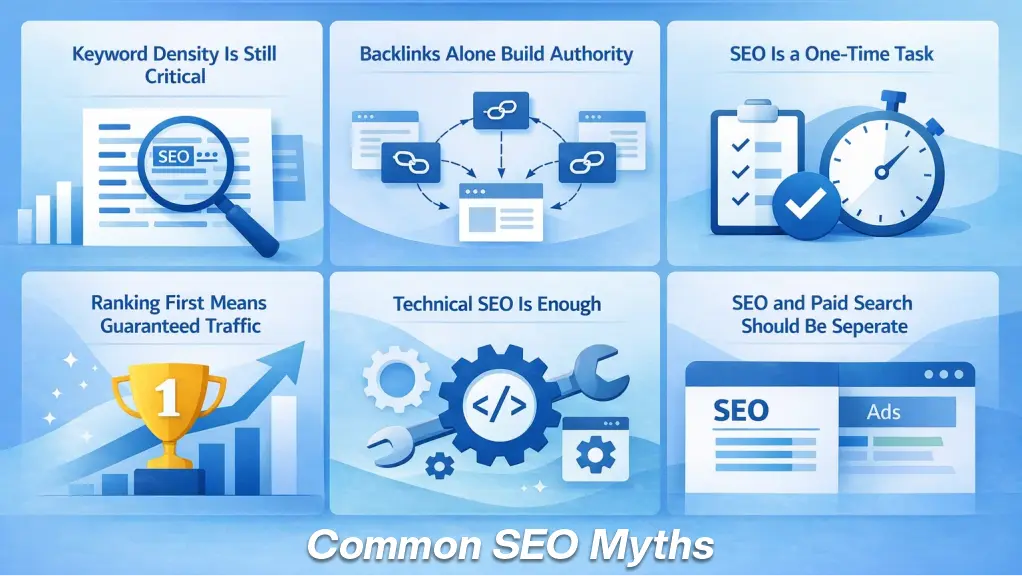
Despite this shift, a large number of companies operating in Dubai and Abu Dhabi continue to build their SEO strategies on assumptions that are no longer valid. These assumptions are not always obvious. In fact, many of them sound logical on the surface, which is precisely why they persist. The issue is not that these businesses are careless. It is that they are following advice that has not aged well.
Search engines today are less interested in what a page claims to be about and far more interested in whether it genuinely helps someone move forward. They assess usefulness, intent alignment, and behavioural signals at scale. When SEO strategies fail to account for this, rankings may appear temporarily, but they rarely convert into consistent visibility or leads.
At C2C Media, we regularly audit websites across the UAE that look strong from a traditional SEO perspective. Keywords are present. Pages are indexed. Technical health scores are acceptable. Yet organic enquiries remain weak or inconsistent. In most cases, the problem is not effort or spending. It is reliance on SEO myths that no longer reflect how modern search works.
This article explores the most common SEO myths still shaping decision-making in the UAE, explains why they refuse to disappear, and clarifies what actually drives sustainable organic growth in today’s market.
Why SEO Myths Still Hold Power in the UAE?
The UAE digital market is fast, competitive, and results-driven. Businesses move quickly, expectations are high, and patience is limited. In that environment, simplified SEO advice feels attractive. It promises control in a space that often feels unpredictable.
Many SEO myths began as legitimate strategies. Keyword repetition once helped relevance. Backlinks once acted as a reliable authority shortcut. One-time optimisation once delivered visible gains. These ideas persist because they worked before. The mistake is assuming they still work in the same way.
Google itself confirms that more than 15% of searches performed every day are completely new. These are queries that have never been searched before, shaped by changing behaviour, new products, and evolving language.
In a market like the UAE, where users come from different cultures, languages, and buying mindsets, rigid SEO frameworks struggle to keep pace with reality.
Why Search Engines Move Faster Than SEO Advice?

Search engines no longer operate on fixed rules. They are adaptive systems that learn continuously from user behaviour. Google introduces thousands of refinements to its search systems every year, many of which are never publicly detailed.
These refinements adjust how intent is interpreted, how trust is inferred, and how topics are connected. SEO advice, however, is often recycled, simplified, and repeated long after its effectiveness has faded. This gap between how search engines evolve and how SEO is commonly practised is where myths survive.
Myth One: Keyword Density Is Still Critical
Keyword density is one of the oldest SEO beliefs, and it refuses to die. There was a time when repeating a phrase helped search engines understand relevance. Pages were optimised around percentages rather than meaning, that approach no longer reflects how search works.
In the UAE, keyword-heavy writing is particularly damaging because user behaviour is overwhelmingly mobile-first. People skim content quickly. They lose patience with awkward phrasing. They exit pages that feel written for algorithms rather than humans.
Mobile devices now account for over 76% of global web traffic, a pattern clearly visible in Dubai and Abu Dhabi.
Search engines monitor how users behave once they land on a page. If engagement drops, rankings follow, regardless of how “optimised” the text appears.
Why Intent Replaced Repetition?
Modern search systems focus on why someone searches, not just what they type. They analyse context, related concepts, and whether content genuinely resolves the underlying need. This is why effective SEO & SEM Services now prioritise intent mapping, narrative clarity, and depth of explanation over keyword formulas.
Content that answers questions naturally, anticipates concerns, and supports decision-making consistently performs better than pages written to satisfy density metrics.
Our approach focuses on intent, experience, and sustained organic growth.
SEO that works beyond page one.
Myth Two: Backlinks Alone Build Authority
Backlinks still matter, but their role has narrowed. In competitive UAE sectors, most established websites already possess baseline authority. Acquiring additional links without improving relevance rarely delivers lasting improvement.
Research by Ahrefs shows that over 90% of web pages receive no organic traffic, largely because they fail to match search intent rather than because they lack backlinks.
Search engines now assess whether links reinforce topical credibility instead of simply inflating authority scores.
Why Topical Authority Matters More?
Authority today is demonstrated through focus and consistency. Search engines evaluate whether a website covers a subject thoroughly and connects related ideas logically over time. Businesses supported by a strong branding agency UAE often perform better here because clear positioning strengthens trust and coherence across content.
Myth Three: SEO Is a One-Time Task
Many businesses still approach SEO as a setup process. Pages are optimised, indexed, and then left untouched. In a fast-moving market like Dubai, this approach guarantees decline.
Search intent evolves. Competitors publish continuously. Algorithms reassess relevance signals on an ongoing basis. Static optimization loses effectiveness, even when initial rankings look promising.
Why Ongoing Refinement Is Essential?
Modern SEO requires regular attention. Content needs updating as behaviour changes. Internal links must evolve as websites grow. Businesses that integrate SEO with Performance Marketing Services gain an advantage by using paid campaign data to identify emerging demand and refine organic strategies accordingly.
Myth Four: Ranking First Means Guaranteed Traffic
High rankings no longer guarantee clicks. Search results pages are crowded with featured snippets, local packs, and instant answers that often satisfy queries without a website visit.
Studies show that 57% of searches result in no click, meaning users obtain information directly from the results page.
In mobile-first UAE markets, this behaviour is especially common. Visibility today depends on clarity, credibility, and relevance, not position alone.
Myth Five: Technical SEO Is Enough
Technical optimization is necessary, but it is not persuasive. Fast load times and clean code allow pages to compete, but they do not build confidence or trust.
Websites that focus only on technical SEO often plateau. In the UAE, where users compare options quickly, content quality and authority heavily influence decisions. This is why many businesses work with dynamic website development partners in UAE to ensure performance, structure, and content strategy evolve together.
Myth Six: SEO and Paid Search Should Be Separate
Organic and paid search are often managed in isolation, even though both are driven by the same user intent. Paid campaigns provide immediate insight into language, behaviour, and conversion pathways.
When SEO ignores this data, content strategy falls behind real demand. Businesses that align organic efforts with Search Engine Marketing Services make more informed decisions because they rely on observed behaviour rather than assumptions.
What Actually Works in UAE SEO Today?

SEO success today is built on alignment. Search engines reward websites that demonstrate consistency across content quality, structure, and experience. Google’s Search Quality Evaluator Guidelines emphasise E-E-A-T (Experience, Expertise, Authoritativeness, and Trustworthiness) as indicators of quality.
Effective UAE strategies prioritise depth over volume, clarity over shortcuts, and credibility over manipulation. This aligns naturally with long-term digital marketing strategies UAE designed for sustainable growth.
How UAE Businesses Should Approach SEO in 2026?
SEO should be treated as an integrated growth system rather than a standalone tactic. It intersects with branding, website experience, content development, and acquisition channels.
Businesses that achieve consistent organic growth align SEO with paid insights, invest in meaningful content, and optimize continuously rather than reactively. Many see stronger results by working with a performance marketing agency in Dubai that understands how channels support each other.
Why Authority-Led Content Wins Long Term?

Search engines increasingly reward content that reflects real experience and professional judgement. Generic explanations no longer satisfy users or algorithms.
For UAE businesses, this means content must reflect regional behaviour, purchasing considerations, and competitive realities. When executed correctly, this positions a company as one of the best SEO agencies in UAE in the eyes of both users and search engines.
Conclusion:
SEO myths persist because they oversimplify a complex discipline. In competitive UAE markets, oversimplification leads to stagnation.
Search engines now reward relevance, usefulness, and trust. Businesses that abandon outdated assumptions and adopt an intent-driven, integrated approach place themselves in a stronger position for long-term visibility and growth.
SEO today is not about manipulating signals. It is about understanding users, structuring information responsibly, and evolving alongside behaviour and technology. This is the foundation on which C2C Media builds sustainable digital success.
We build SEO strategies that align with real user intent and long-term growth in the UAE market.
Ready to move beyond outdated SEO tactics?