

GEO vs AEO vs SEO: What’s the Difference and How to Optimize for All Three
The marketing world is hitting a dead end, facing its biggest shake-up since the smartphone went mainstream. If you’re still betting the house on backlink hunting and meta-tag tweaks, your strategy is built on a deck of cards. The numbers don’t lie: traditional search traffic is expected to tank by 25% by 2026. This isn’t just a glitch; it’s happening because AI bots and smart assistants are doing the work for us, giving people instant answers and cutting out the website visits that brands have lived on for years.
Getting a handle on the friction between GEO vs AEO vs SEO has moved from a “nice-to-have” experiment to a flat-out requirement for staying relevant. It doesn’t matter if someone is typing a phrase into a search bar, shouting a question at Siri from their kitchen, or reading a quick summary from a chatbot; your brand has to show up in that mix.
Learning the real difference between GEO vs AEO vs SEO is your best defense against a future where “zero-click” results become the standard. In this high-stakes environment, just landing on the first page isn’t enough; you need to be the source that AI chooses to cite, speak, and trust.
Defining the Pillars: GEO vs AEO vs SEO
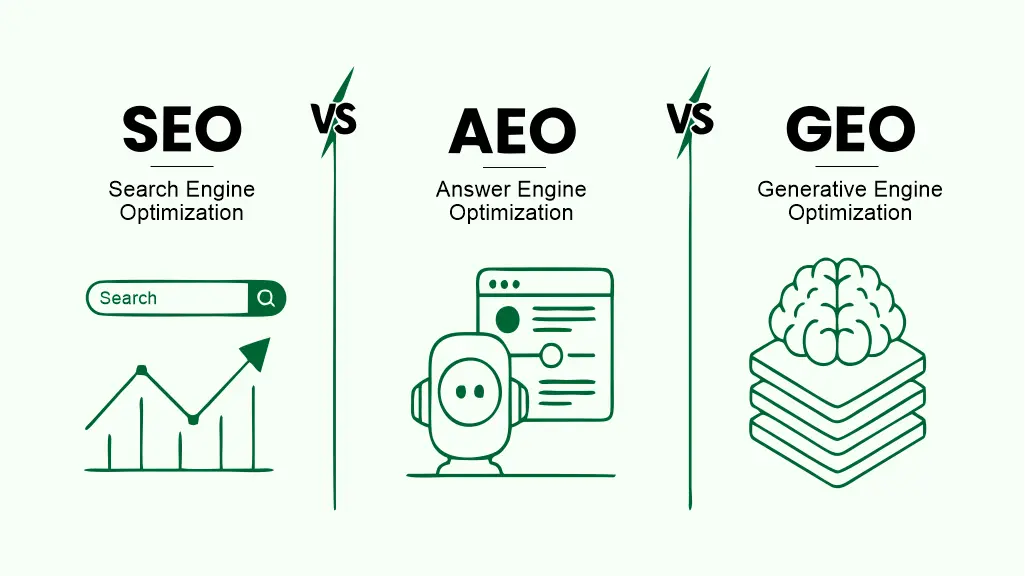
To build a strategy that covers all bases, we must first define the three pillars of modern findability. While they all aim to increase visibility, they target different layers of user intent and technical delivery.
1. Search Engine Optimization (SEO)
SEO remains the foundation of the digital ecosystem. It is the process of optimizing your website’s technical architecture and content to rank in traditional search engines like Google or Bing.
The goal is to drive organic traffic by appearing in the “blue links” that users click to find deep-dive information. In the context of GEO vs AEO vs SEO, SEO is the “plumbing” that allows all other optimizations to function.
Without a crawlable, fast, and secure site, AI engines won’t even find your data to summarize it.
2. Answer Engine Optimization (AEO)
AEO is a more surgical approach. This approach is all about getting straight to the point. AEO is built to grab “Position Zero”, those featured snippets, “People Also Ask” blocks, and the quick answers Siri or Alexa read out loud.
When someone asks a specific question, AEO makes sure your content is the one that gets picked to be displayed or spoken. It acts as the link between old-fashioned searching and the new world of AI by putting a premium on clear, logical organization.
Usually, getting your SEO Optimization right is the first step toward actually winning at AEO.
3. Generative Engine Optimization (GEO)
GEO is the newest and perhaps most complex frontier. It involves optimizing content specifically for AI models like Gemini, ChatGPT, and Perplexity. Unlike SEO, which focuses on ranking, GEO focuses on citation.
The goal is to get the AI to mention your brand and link to your site as a source of truth within its generated summary. AEO and GEO In Digital Marketing are now the primary ways to capture the attention of Gen Z users, who increasingly prefer AI platforms over Google for their daily searches.
Search is evolving beyond traditional SEO.
Partner with C2C Media to optimize your business for GEO vs AEO vs SEO and stay visible in AI-driven search results.
The Detailed Difference: GEO vs AEO vs SEO
Understanding the Difference Between GEO vs AEO vs SEO requires looking at how each system processes information. SEO is about being “found” in a list. AEO is about being “the answer.” GEO is about being “the source.”
Traditional SEO relies on keywords and backlinks to signal authority. If you have high domain authority, Google moves you up the list. However, AI models (GEO) don’t just look at who has the most links. They look for “Information Gain”; unique data or insights that don’t exist elsewhere.
You might rank #1 on Google for “best running shoes,” but if your article is a generic listicle, a generative engine might skip you in favor of a lower-ranking site that provides a unique lab-tested durability score.
AEO sits in the middle. It requires the technical health of SE, O, but the conciseness of a chat response. It is the art of being “machine-readable.” If your SEO Optimization includes long, flowery introductions, you will likely fail at AEO. Answer engines want the “What,” “Why,” and “How” delivered in the first 50 words of a section.
Furthermore, Generative Engine Optimization, in the practice of optimizing for local intent, is becoming a massive part of the AEO/GEO world. Local intent is the primary driver for voice search.
When someone asks, “Where is the best pizza near me?”, the answer engine pulls from your local SEO signals, but the generative engine might synthesize reviews from Yelp, TripAdvisor, and your own site to give a reasoned recommendation.
The Evolution of SEO Optimization in 2026
Traditional SEO Optimization is not dead, but it has become much more selective. Because AI overviews now appear in nearly 50% of Google search results, the “middle ground” of content is dying. If your content is just a summary of what’s already on the web, users will read the AI summary and never click your link.
To win in SEO now, you must focus on “Double-E-A-T” (Experience, Expertise, Authoritativeness, and Trustworthiness). Google is raising the bar, favoring content that shows real-world experience. For example, a travel blog shouldn’t just list “10 things to do in Paris.”
It needs to show photos of the author actually doing those things and provide “inside” tips that an AI couldn’t hallucinate. This high-level SEO Optimization creates the authority that Google engines then use to cite your brand.
Strategic AEO: Capturing the Voice of the Customer
AEO is about winning the “Zero-Click” battle. Statistics show that roughly 60% of mobile searches now end without a single click because the user found the answer in a snippet or voice response. This is why AEO and GEO in Digital Marketing are becoming a combined department in many agencies.
To optimize for AEO, you must adopt an “Answer-First” writing style. Every blog post should contain an FAQ section or a summary box. If you are discussing the Difference Between GEO vs AEO vs SEO, start the section with a clear, one-sentence definition for each.
This allows the “Answer Engine” to scrape your site easily. Use H2 and H3 tags as the questions themselves. This structure is the “cheat code” for appearing in the “People Also Ask” sections that dominate the modern SERP.
Masterclass in GEO: Becoming the AI’s Primary Source
Generative Engine Optimization is about building a “signal trail” across the internet. AI models are trained on massive datasets, including Reddit, LinkedIn, and niche forums. If you want a generative engine to recommend your product, you need to be talked about in places where humans congregate.
A core tactic for GEO is the implementation of an llms.txt file. This is the 2026 equivalent of a sitemap: a markdown file in your root directory that provides a simplified, text-only map of your site’s most important facts.
It tells AI crawlers exactly what your brand does without them getting lost in your website’s code. When we look at GEO vs AEO vs SEO, GEO is the only one that truly requires you to think like a data scientist rather than just a marketer.
Factual provenance is another key factor. AI models love specific, data-backed claims. Instead of saying “Our software is fast,” say “Our software reduces latency by 45% compared to industry standards.”
These specific metrics are “sticky” for AI models and are far more likely to be cited. This is where Generative Engine Optimization also integrates; if your local data is precise and consistent across the web, the AI will trust your location as a primary recommendation.
Deep Dive into Technical GEO Strategies
To truly excel in GEO, you must understand “Citation Flow.” Generative engines don’t just pick the biggest site; they pick the most relevant citation. This is a massive shift from the Difference Between GEO vs AEO vs SEO strategies of the past.
In GEO, your content must be “chunkable.” Each paragraph should be able to stand alone as a valuable piece of information that an AI can extract and present to a user.
Another critical element is “Sentiment Control.” Because AI models are trained on public discourse, what people say about you on Reddit or X (formerly Twitter) matters as much as what you say on your own website.
AEO and GEO In Digital Marketing now require a PR-focused approach where you monitor brand mentions across the social web to ensure the training data for these models remains positive.
Furthermore, the rise of Generative Engine Optimization means that for local businesses, your “Google Business Profile” is no longer just a listing; it is a data source for the AI’s local reasoning. If a user asks a generative engine, “Which plumber in Chicago is best for emergency pipe bursts?”, the AI will look at your response times and customer reviews to synthesize an answer.
Content Density and the Death of Fluff
In the world of SEO Optimization, “fluff” was often used to hit word count targets. In the world of GEO and AEO, fluff is a death sentence. AI models have limited “context windows.” If you bury your value under 500 words of introductory rambling, the AI might discard your page entirely.
The ongoing GEO vs AEO vs SEO shift makes one thing clear: filler is a liability. In the GEO vs AEO vs SEO era, filler is a liability. You need to pack your writing with hard facts, ensuring every sentence pulls its weight.
This isn’t about being brief; it’s about making sure your breakdown of the Difference Between GEO vs AEO vs SEO offers a unique angle or data point that isn’t just a copy of the top Google results. High-density content is the only way to survive when generic pages are everywhere.
The Role of Structured Data (Schema Markup)
Ignoring Schema markup is like shouting into a void. Without this code, you are speaking a language that AI and search engines simply cannot parse.
Using Schema gives these bots a direct map of your data, which is vital for sharp SEO Optimization and making sure your brand isn’t misinterpreted.
When comparing SEO Vs AEO Vs GEO, you’ll find that Schema is the one tool that helps you win across all three.
When you look at SEO, AEO Vs GEO, you see that Schema is the common thread. SEO uses it for rich snippets; SEO uses it to find direct answers; and GEO uses it to verify the facts it is citing.
Generative Engine Optimization also relies heavily on the “LocalBusiness” schema to verify addresses and service areas. Without this structured foundation, your SEO Optimization efforts will be capped by the engine’s inability to categorize your data.
Managing Brand Authority in a Generative World
Authority is no longer just about backlinks; it’s about “Entity Recognition.” Google and AI models now view brands as entities with specific attributes. If you want to dominate in GEO vs AEO vs SEO, you need to ensure your entity is clearly defined across the web.
This means consistency is key. Your brand’s founding date, your CEO’s name, and your core services must be identical across your website, Wikipedia, LinkedIn, and news articles. Any discrepancy can cause an AI to flag your information as unreliable, which is the quickest way to lose a citation in a generative summary. This holistic view is the hallmark of modern AEO and GEO in Digital Marketing.
Why “Zero-Click” is the New Normal
We have to face the reality that a large portion of search traffic will never reach your website. In an SEO-driven world, the user gets the answer and leaves. While this sounds scary, it is actually an opportunity. When an AI provides your brand as the answer, it builds immense brand equity.
Even if they don’t click today, the next time they need a service, they will remember your brand as the one the AI recommended. This is why understanding the Difference Between SEO, AEO, and GEO is about more than just traffic; it’s about mindshare. Your SEO Optimization should aim for high-intent traffic, while your AEO and GEO strategies aim for brand authority and trust.
Integrating All Three into a Unified Workflow
You cannot afford to treat these as separate silos. A modern content strategy must be a “Visibility Flywheel.” You start with a deep-dive, original research piece (SEO), deconstruct it into concise, question-based snippets (AEO), and then promote it across high-authority platforms to build the brand signals needed for AI citations (GEO).
When assessing SEO Vs AEO Vs GEO, remember that they all feed into each other. Good SEO builds the site’s authority. A good AEO makes that authority accessible for quick answers. Good GEO ensures that even if a user never visits a search engine, your brand is the one the AI mentions in its private conversation with the user. This is the essence of SEO Optimization in the generative age; it’s no longer about a single destination; it’s about being ubiquitous.
Every time you write a blog post, ask yourself:
- Does this provide a unique insight for SEO?
- Can a specific section be used as a 40-word answer for AEO?
- Is the data structured clearly enough for a generative engine (GEO) to cite it?
If the answer is yes to all three, you are practicing the most advanced form of AEO and GEO in Digital Marketing available today. Don’t forget that Generative Engine Optimization should also be a constant checkpoint if your business relies on local customers.
Conclusion
The era of relying solely on “blue links” for traffic is officially over. As AI agents begin to shop, research, and book appointments on behalf of users, the digital landscape will become increasingly “agentic.” If you fail to align your brand with the realities of GEO vs AEO vs SEO, you are essentially vanishing from the view of the automated agents that will soon dictate how people buy and browse.
By 2026, real-world authority will be the only thing that matters as AI pumps out a massive volume of generic content. By truly grasping the Difference Between SEO, AEO, and GEO and focusing on original research, a rock-solid technical foundation, and a consistent presence across the web, you can keep your brand from being ignored. Whether a human is hunting for a fix or a bot is pulling together a summary, your data must be the most trustworthy source they encounter.
Moving from basic SEO Optimization to a strategy that handles multiple engines at once is a long game, not a quick fix. But the people who figure out how to navigate SEO Vs AEO Vs GEO right now are going to be the ones running the show as the “synthesized web” takes over. Stick to high-quality work, make your data easy for machines to read, and never stop trying to be the most useful voice in your field.
Want to dominate search results across Google, AI answers, and local search?
Contact C2C Media today and build a future-ready SEO strategy optimized for GEO, AEO, and SEO success.